A COUPLE of weeks ago, October 14 to be exact, a Wall Street Journal article titled “Abolish Women’s Chess Titles” created a big stir that drew reactions from various web and blog sites. The author, Ms. Barbara Jepson, posited that awarding titles for women at lower levels of accomplishment is an “anachronistic and demeaning practice.” She views women’s chess titles as “gender-segregated,” which US international master (yes, that’s a chess title for men) Irina Krush described as “really a marker of lower expectations.”
The full article can be read from http://online.wsj.com/article/SB10001424052748703298004574457393421190888.html.
The Chess Connoisseur would have preferred to keep mum on the issue because the writer of the article is not known as a chess player and has used only the view of 25-year-old Ms. Krush as authority to add some chess credibility to her article. However, his attention was caught when Women World Chess Champion Alexandra Kosteniuk, herself having a grandmaster title for men, strongly reacted to the WSJ article in her October 17, 2009 post, titled: “Abolish Women’s Titles? Ridiculous!” in her blog site, http://www.chessblog.com/.
Ms. Kosteniuk’s lengthy reaction is summarized by this statement: “The proposal of abolishing women's chess titles is absurd, sounds more like a title for a "yellow" newspaper rather than the Wall Street Journal to attract attention, and would hurt rather than help getting more girls and women to play chess.” (Emphasis by the Chess Connoisseur)
Ms. Jepson, who writes about music and art for the Journal, is researching child prodigies in multiple disciplines.
Ms. Kosteniuk is a co-chairperson of the FIDE Commission for Women’s Chess. Her twin proposals: the annual FIDE Caissa Award for best female chess player and the annual FIDE Golden Women’s Tournament Organizer Award, were approved in the most recent FIDE Executive Board meeting held on October 12 in conjunction with the 80th FIDE Congress that took place in Kallithea, Khalkidhiki, Greece from October 11 to 18.
.
Friday, October 30, 2009


Thursday, October 29, 2009
Chess – Palau style
THE 12-man round robin finals of the 2009 Palau chess championship is underway. The Chess Connoisseur initially reported its commencement in its August 20, 2009 post. A last minute change in the format, following the suggestion of PNG’s Joselito Marcos, brought about an exciting 5-round Swiss system qualifying event where the top 8 placers joined Palau’s 4 FIDE-rated players in the single round robin finals.
Our correspondent, Tia Belau’s chess columnist Roberto Hernandez, himself a finalist and among the indefatigable organizers of this year’s event, sent us scores of completed games and results. In his Chessmate column in the country’s weekly newspaper, Hernandez reported that those who failed to make it to the finals play in the consolation group, also a round robin event with prizes for winners.
The nature and the schedule of work of chess participants prohibit all games of a round to be completed on a single day. In the consolation group, one contestant withdrew his participation because of conflict in his job schedule. Hernandez explained ‘Palau has the most flexible chess schedule in the world to accommodate ALL players whatever their schedules are.’
Despite the explanation the player still withdrew from the formal competition. Before leaving, however, he played–and won!–a couple of games with bets against an available finalist.
Games are played in two venues and participants play against whoever is available regardless of round because of the all-play-all format. As such only provisional standings can be shown because of different number of completed games per player.
Well, that’s Palau chess!
Here are the latest interim standings of 2009 Palau Chess Championship.
 Diagram 1 – Position after 29… Kh8.
30.Qxd6?
White went pawn hunting and overlooked a forced mate in five moves: 30.Rh7+! Kxh7 31.Qd7+ Qe7 32.Qxe7+ Rf7 33.Qxf7+ Kh8 34.Qg7#!
After 30... Qe3+ 31.Kf1, Black himself came up with a rook sacrifice of his own with 31… Rxf3+! which was only good for a draw but enough to keep his unbeaten streak. A draw could still be achieved without sacrifice through queen checks but Black wanted to get it with flourish. The game concluded with 32.gxf3 Qxf3+ 33.Kg1 Qd1+ 34.Kh2 Qxc2+ ½–½.
Equal second seed, Cyril Montel Jr (FIDE rating, 1870), registered the shortest victory so far —a 20-mover—in his game against Paquito Suringa Jr. It could have been shorter by 4 moves if only Montel (Black) found the forced mate on his 11th turn.
Here is the game with light notes from The Chess Connoisseur.
1.d4 Nf6 2.Nc3 g6 3.e4 d6 4.d5?
An early mistake. Against the principle of moving the same piece twice, this move aggravates the infraction by unnecessarily opening up the a1-h8 diagonal for Black’s fianchettoed bishop.
4… Bg7 5.Bd2 c6 6.Bc4?
Another inaccuracy, which Black exploited to initiate an attack on White’s king. Better was 6.Nf3 0–0 7.Be2 Nbd7, but Black still has a slight edge.
6... b5 7.Bb3 b4 8.Nce2?
White could have maintained material equality with 8.Na4, but Black has a clear advantage.
8... Nxe4 9.Bxb4
If 9.Nf3, then 9… Bxb2 wins.
9... Qb6!
Hitting simultaneously the bishop at b4 and the f2-square which effectively decided the game. White must give up a piece to avert the threatened mate at f2.
10.Nd4 Bxd4 11.Bxd6
Surrendering another piece. Instead if 11.Bd2, Black weaves a mating net starting with 11… Bxf2+ 12.Ke2 Ba6+ 13.Kf3 Nd7 14.g3, and now the surprisingly sparkling move 14… Bf1!! finishes off White.
 Diagram 2 – Position after 11.Bxd6?
11... exd6?!
A rather prosaic way of winning the game. Instead, Black has a forced mate in five moves with 11... Bc3+!! 12. Ke2 (12.bxc3 Qxf2#) 12... Ba6+ 13.Kf3 (13.Bc4 Bxc4+ just prolongs the game by one move) 13… Qxf2+ 14.Kg4, and Black has choices of mate among 14… h5+ 15.Kh3 Ng5#; 14... f5+ 15.Kh3 Ng5#; and 14... Qf5+ 15.Kh4 Bf6#.
12.Nf3 Bxf2+ (Still missing the decisive 12... Bc3+!) 13.Kf1 Ba6+ 14.c4 0–0 15.Qe2 cxd5 16.Rd1 Nd7 17.Rxd5 Ndf6 18.Rd3 d5 19.Rd1 Ng4 20.Rd3 Nxh2+ 0–1
Disaster struck when fourth-seed Roberto Hernandez (White), a whole rook up, suffered an upset loss against qualifier Masum Billah, a Bangladeshi.
 Diagram 3 – Position after 25… Kg6
26.h5+?
Good only for a draw. The order of the day was to bring the queen back to action with 26.Qe8+. After 26… Kf5 27.Rf8+ Kg4 (if 27... Ke5 28.Qb8+ Ke4 29.Qd6! wins), then 28.Qb5! (A difficult-to-visualize continuation in the midst of checking the opponent’s king) 28… Qe3+ 29.Rf2 Kxg3 30.Qf1, defends White’s king and keeps his attack on.
26... Kf5 27.Rf8+??
The losing moment. White checked with the wrong piece that led to his downfall. Correct was 27.Qf8+! Nf6 28.Qxg7 Qd1+ 29.Kg2 [but not 29.Kh2??, or 29. Kf2??, because of 29… Ng4+ 30.Kg2 Qe2+ 31.Kg1 Qf2+ (31... Qh2+ 32.Kf1 Qf2#) 32.Kh1 Qh2#] 29... Qe2+ 30.Kg1 Qe1+, with equality.
27... Kg4! 28.Rf2 (28.Qb8 Nf6 wins) 28... Qe1+ 29.Rf1 Qxg3+ 30.Kh1 Kh3 31.Qxd5 exd5 0–1
Games between players without much tournament exposures usually lead to comedy of errors. The winner in the following game, as Savielly Tartakover once said, was ‘the player who made the next to the last mistake.’
Mahor,Jun - Garcia,Bernard
Palau Chess Championship, Koror, 18.10.2009
The moves leading to the diagram were: 1.e4 e5 2.Nf3 Nc6 3.a3?! When an amateur plays a move like this annotators readily put a question mark, while if a professional does it an interesting move “!?” is appended. A case of double standard in annotating games. 3… Nd4 4.c3 Nxf3+ 5.Qxf3 Nf6 6.d4 d6 7.h3 c6 8.Bg5 Be7 9.Nd2 Qb6 10.Nc4 Qc7 11.Bd3 Be6 12.0–0 Bxc4 13.Bxc4 Qb6 14.dxe5 dxe5 15.Qf5 Qc7 16.Bxf6 Bxf6 17.Rad1 0–0 18.Rd7 Qc8 19.Rfd1 b5 20.Ba2 a5 21.g4 h6 22.h4 Bxh4 23.Bxf7+ Kh8 24.Qg6 Bf6 25.Be6 Qe8 26.Bf7 Rxf7 27.Qxf7 Qc8 28.f3 Qa6
 Diagram 4 – Position after 28... Qa6.
29.Kg2
Better was 29.g5! If 29… hxg5, then 30.Kg2 g4 31.Rh1+ Bh4 32.Qxg7# (32.Rxh4#).
29... Rg8 30.g5!?
One move too late. Better was 30.R1d6! b4 31.c4 Qc8 32.Rxf6! wins.
30... Bxg5 31.Qg6
It is still not late for 31.R1d6. White wins after 31… b4 32.c4 Qa8 33.Rg6 Qe8 34.Qxe8 Rxe8 35.axb4 axb4 36.Rxc6.
31... b4 32.Kg3
32.Qxg5! wins.
32... Qe2 33.Rg1??
A blunder. The correct move, 33.Qxg5, still wins for White.
33... Bf4+!
Turning the table.
34.Kg4 Qf2?
Black’s turn to err. Instead, 34... Bh2! wins.
35.Kf5 Qxf3 36.Ke6 Qh3+ 37.Rg4??
White blundered anew and failed to make the most of his chances. Instead, 37.Qf5 Qxf5+ 38.exf5 would give White a slight advantage.
37... h5!
It’s all over. The game concluded with 38.Rxg7 Qxg4+ 39.Qxg4 hxg4 40.Rc7 Rg6+ 41.Kf7? Rg7+ 0–1.
.
Our correspondent, Tia Belau’s chess columnist Roberto Hernandez, himself a finalist and among the indefatigable organizers of this year’s event, sent us scores of completed games and results. In his Chessmate column in the country’s weekly newspaper, Hernandez reported that those who failed to make it to the finals play in the consolation group, also a round robin event with prizes for winners.
The nature and the schedule of work of chess participants prohibit all games of a round to be completed on a single day. In the consolation group, one contestant withdrew his participation because of conflict in his job schedule. Hernandez explained ‘Palau has the most flexible chess schedule in the world to accommodate ALL players whatever their schedules are.’
Despite the explanation the player still withdrew from the formal competition. Before leaving, however, he played–and won!–a couple of games with bets against an available finalist.
Games are played in two venues and participants play against whoever is available regardless of round because of the all-play-all format. As such only provisional standings can be shown because of different number of completed games per player.
Well, that’s Palau chess!
Here are the latest interim standings of 2009 Palau Chess Championship.
  1. Jun Mahor                 2½/4
2-4. Roberto Hernandez    1830  2/3
     Menandro Manuel      1942  2/2
     Cyril Montel, Jr.    1870  2/2
  5. Romeo Caballes            1½/5
6-9. Bernard Garcia             1/1
     Masum Billah               1/4
     Gene Pastrana        1870  1/1
     Paquito Suringa, Jr.       1/3
 10. Michael Mercado            ½/1
 11. Elpidio Manaligod          ½/2
 12. Craig Dittrich             0/2
Here are some selected games from the ongoing event.
An upset right on the first day of the championship finals was in the making when top qualifier, Michael Mercado (Black), who topped the qualifying event with a perfect score of 5 points, found himself in this position against qualifiers’ runner up Jun Mahor.
 Diagram 1 – Position after 29… Kh8.
White went pawn hunting and overlooked a forced mate in five moves: 30.Rh7+! Kxh7 31.Qd7+ Qe7 32.Qxe7+ Rf7 33.Qxf7+ Kh8 34.Qg7#!
After 30... Qe3+ 31.Kf1, Black himself came up with a rook sacrifice of his own with 31… Rxf3+! which was only good for a draw but enough to keep his unbeaten streak. A draw could still be achieved without sacrifice through queen checks but Black wanted to get it with flourish. The game concluded with 32.gxf3 Qxf3+ 33.Kg1 Qd1+ 34.Kh2 Qxc2+ ½–½.
Equal second seed, Cyril Montel Jr (FIDE rating, 1870), registered the shortest victory so far —a 20-mover—in his game against Paquito Suringa Jr. It could have been shorter by 4 moves if only Montel (Black) found the forced mate on his 11th turn.
Here is the game with light notes from The Chess Connoisseur.
1.d4 Nf6 2.Nc3 g6 3.e4 d6 4.d5?
An early mistake. Against the principle of moving the same piece twice, this move aggravates the infraction by unnecessarily opening up the a1-h8 diagonal for Black’s fianchettoed bishop.
4… Bg7 5.Bd2 c6 6.Bc4?
Another inaccuracy, which Black exploited to initiate an attack on White’s king. Better was 6.Nf3 0–0 7.Be2 Nbd7, but Black still has a slight edge.
6... b5 7.Bb3 b4 8.Nce2?
White could have maintained material equality with 8.Na4, but Black has a clear advantage.
8... Nxe4 9.Bxb4
If 9.Nf3, then 9… Bxb2 wins.
9... Qb6!
Hitting simultaneously the bishop at b4 and the f2-square which effectively decided the game. White must give up a piece to avert the threatened mate at f2.
10.Nd4 Bxd4 11.Bxd6
Surrendering another piece. Instead if 11.Bd2, Black weaves a mating net starting with 11… Bxf2+ 12.Ke2 Ba6+ 13.Kf3 Nd7 14.g3, and now the surprisingly sparkling move 14… Bf1!! finishes off White.
 Diagram 2 – Position after 11.Bxd6?
A rather prosaic way of winning the game. Instead, Black has a forced mate in five moves with 11... Bc3+!! 12. Ke2 (12.bxc3 Qxf2#) 12... Ba6+ 13.Kf3 (13.Bc4 Bxc4+ just prolongs the game by one move) 13… Qxf2+ 14.Kg4, and Black has choices of mate among 14… h5+ 15.Kh3 Ng5#; 14... f5+ 15.Kh3 Ng5#; and 14... Qf5+ 15.Kh4 Bf6#.
12.Nf3 Bxf2+ (Still missing the decisive 12... Bc3+!) 13.Kf1 Ba6+ 14.c4 0–0 15.Qe2 cxd5 16.Rd1 Nd7 17.Rxd5 Ndf6 18.Rd3 d5 19.Rd1 Ng4 20.Rd3 Nxh2+ 0–1
Disaster struck when fourth-seed Roberto Hernandez (White), a whole rook up, suffered an upset loss against qualifier Masum Billah, a Bangladeshi.
 Diagram 3 – Position after 25… Kg6
Good only for a draw. The order of the day was to bring the queen back to action with 26.Qe8+. After 26… Kf5 27.Rf8+ Kg4 (if 27... Ke5 28.Qb8+ Ke4 29.Qd6! wins), then 28.Qb5! (A difficult-to-visualize continuation in the midst of checking the opponent’s king) 28… Qe3+ 29.Rf2 Kxg3 30.Qf1, defends White’s king and keeps his attack on.
26... Kf5 27.Rf8+??
The losing moment. White checked with the wrong piece that led to his downfall. Correct was 27.Qf8+! Nf6 28.Qxg7 Qd1+ 29.Kg2 [but not 29.Kh2??, or 29. Kf2??, because of 29… Ng4+ 30.Kg2 Qe2+ 31.Kg1 Qf2+ (31... Qh2+ 32.Kf1 Qf2#) 32.Kh1 Qh2#] 29... Qe2+ 30.Kg1 Qe1+, with equality.
27... Kg4! 28.Rf2 (28.Qb8 Nf6 wins) 28... Qe1+ 29.Rf1 Qxg3+ 30.Kh1 Kh3 31.Qxd5 exd5 0–1
Games between players without much tournament exposures usually lead to comedy of errors. The winner in the following game, as Savielly Tartakover once said, was ‘the player who made the next to the last mistake.’
Mahor,Jun - Garcia,Bernard
Palau Chess Championship, Koror, 18.10.2009
The moves leading to the diagram were: 1.e4 e5 2.Nf3 Nc6 3.a3?! When an amateur plays a move like this annotators readily put a question mark, while if a professional does it an interesting move “!?” is appended. A case of double standard in annotating games. 3… Nd4 4.c3 Nxf3+ 5.Qxf3 Nf6 6.d4 d6 7.h3 c6 8.Bg5 Be7 9.Nd2 Qb6 10.Nc4 Qc7 11.Bd3 Be6 12.0–0 Bxc4 13.Bxc4 Qb6 14.dxe5 dxe5 15.Qf5 Qc7 16.Bxf6 Bxf6 17.Rad1 0–0 18.Rd7 Qc8 19.Rfd1 b5 20.Ba2 a5 21.g4 h6 22.h4 Bxh4 23.Bxf7+ Kh8 24.Qg6 Bf6 25.Be6 Qe8 26.Bf7 Rxf7 27.Qxf7 Qc8 28.f3 Qa6
 Diagram 4 – Position after 28... Qa6.
Better was 29.g5! If 29… hxg5, then 30.Kg2 g4 31.Rh1+ Bh4 32.Qxg7# (32.Rxh4#).
29... Rg8 30.g5!?
One move too late. Better was 30.R1d6! b4 31.c4 Qc8 32.Rxf6! wins.
30... Bxg5 31.Qg6
It is still not late for 31.R1d6. White wins after 31… b4 32.c4 Qa8 33.Rg6 Qe8 34.Qxe8 Rxe8 35.axb4 axb4 36.Rxc6.
31... b4 32.Kg3
32.Qxg5! wins.
32... Qe2 33.Rg1??
A blunder. The correct move, 33.Qxg5, still wins for White.
33... Bf4+!
Turning the table.
34.Kg4 Qf2?
Black’s turn to err. Instead, 34... Bh2! wins.
35.Kf5 Qxf3 36.Ke6 Qh3+ 37.Rg4??
White blundered anew and failed to make the most of his chances. Instead, 37.Qf5 Qxf5+ 38.exf5 would give White a slight advantage.
37... h5!
It’s all over. The game concluded with 38.Rxg7 Qxg4+ 39.Qxg4 hxg4 40.Rc7 Rg6+ 41.Kf7? Rg7+ 0–1.
.
Saturday, October 24, 2009
Something new, something old (Part 3)
THIS is the third and last part of the three-part series in the Two Knights Defense. After 1.e4 e5 2.Nf3 Nc6 3.Bc4 Nf6 4.Ng5 d5 5.exd5 Na5 6.Bb5+ c6 7.dxc6 bxc6 8.Be2 h6, White may continue with 9.Nf3 or 9.Nh3. The latter move is examined in this post.
 Diagram 6 – Position after 9.Nh3.
9… Bc5
 Diagram 7 – Position after 9… Bc5.
10.0-0
Against Radoicic, Poughkeepsie 1963, Fischer continued with 10.d3! 0–0 11.Nc3 Re8 12.0–0 Bxh3 13.gxh3 Qd7 14.Bg4 Nxg4 15.hxg4, with the advantage for White.
10… 0–0
After 10... g5 11.Kh1 g4 12.Ng1 Ne4 13.Bxg4! Nxf2+ 14.Rxf2 Bxf2, White has a slight edge according to H. Gottschall.
11.d3 Bxh3
If 11... Nd5, then 12.c4 Ne7 13.Kh1 Bxh3 14.gxh3 Nf5 15.f4 exf4 16.Bxf4 Ne3 17.Bxe3 Bxe3 18.Nc3, White is winning as in Steinitz-Chigorin, Habana WCH(6) 1892.
12.gxh3 Qd7 13.Bf3
13.Bg4?! Nxg4 14.hxg4 f5, with the initiative to Black; 13.Kg2 needs to be tried in practice.
13... Qxh3 14.Nd2
The careless 14.Bg2 is met by 14… Qh4! 15.Qe1 Rfe8! 16.Qxa5 Ng4 17.h3 Bxf2+ 18.Rxf2 Qxf2+ 19.Kh1 e4! 20.hxg4 exd3, wins for Black.
14...Rad8 15.Bg2 Qf5 16.Qe1 Rfe8 17.Ne4 Bb6 18.Nxf6+Qxf6 19.Kh1 c5 20.Qc3! Nc6 21.f4 Nd4 22.Qc4! Qg6 23.c3 Nf5 24.fxe5 Rxe5 25.Bf4.
Here instead of 25… Re2, as in the game Fischer-Bisguier, Poughskeepie 1963, won by White in 29 moves, Black should continue with 25… Ne3 26.Bxe3 Rxe3, with equal chances due to opposite colored bishop. Still Fischer, known for his dogged determination to win and capacity to obtain the maximum from any position, he will certainly pursue a win because all major pieces are still on the board.
Black continues with 9… Bd6
9...Bd6
The move suggested by Steinitz himself.
 Diagram 8 – Position after 9… Bd6.
10.d3!
This is Short’s preferred move since Chigorin’s 10.d4 is effectively countered by Fischer’s 10...e4, when Black is okay.
10… 0–0 11.Nc3 Nd5
Against 11... Rb8?! Short has tried two different continuations:
There are more thickets of variations here.
12.Bf3?! Nxc3! 13.bxc3 Qh4
The knight retreats to h3 – the old approach
9.Nh3!?
 Diagram 6 – Position after 9.Nh3.
In his excellent reference book, The Modern Chess Instructor (1889), the officially acknowledged first world champion Wilhelm Steinitz (1886-1894) recommended 9.Nh3!?–a move that has thoroughly been studied and employed successfully in practice by the 11th world champion Robert Fischer (1972-1975).
This old move, favored by Steinitz although it did not bring him success in his famous 1891 cable match against Chigorin, is a rare guest on top level games. The Steinitz Variation was mostly forgotten until Fischer revived it in the 1960s. English GM Nigel Short, a former world chess challenger, led a second revival of 9.Nh3 in the 1990s, and today it is thought to be about equal in strength to the more common 9.Nf3.
White is not afraid of worsening his pawn structure, after 9… Bxh3 10.gxh3, because he gets the bishop-pair and control of the half-open g-file.
On 9...Bf5, Steinitz gave the continuation 10.0–0 Qd7 11.Re1 Bxh3 12.gxh3 Qxh3 13.Bf1 Qg4+? 14.Qxg4 Nxg4 15.h3, winning for White.
Against 9... g5, White gets the advantage, according to English GM John Nunn, after 10.d3 g4 11.Ng1 Bc5 12.Nc3 Qb6 13.Na4!
Black’s standard choices 9… Bc5 and 9… Bd6 have been busted in practice—the former move by Fischer and the latter by Short. Here is how they did it.
Black continues with 9… Bc5
9… Bc5
 Diagram 7 – Position after 9… Bc5.
10.0-0
Against Radoicic, Poughkeepsie 1963, Fischer continued with 10.d3! 0–0 11.Nc3 Re8 12.0–0 Bxh3 13.gxh3 Qd7 14.Bg4 Nxg4 15.hxg4, with the advantage for White.
10… 0–0
After 10... g5 11.Kh1 g4 12.Ng1 Ne4 13.Bxg4! Nxf2+ 14.Rxf2 Bxf2, White has a slight edge according to H. Gottschall.
11.d3 Bxh3
If 11... Nd5, then 12.c4 Ne7 13.Kh1 Bxh3 14.gxh3 Nf5 15.f4 exf4 16.Bxf4 Ne3 17.Bxe3 Bxe3 18.Nc3, White is winning as in Steinitz-Chigorin, Habana WCH(6) 1892.
12.gxh3 Qd7 13.Bf3
13.Bg4?! Nxg4 14.hxg4 f5, with the initiative to Black; 13.Kg2 needs to be tried in practice.
13... Qxh3 14.Nd2
The careless 14.Bg2 is met by 14… Qh4! 15.Qe1 Rfe8! 16.Qxa5 Ng4 17.h3 Bxf2+ 18.Rxf2 Qxf2+ 19.Kh1 e4! 20.hxg4 exd3, wins for Black.
14...Rad8 15.Bg2 Qf5 16.Qe1 Rfe8 17.Ne4 Bb6 18.Nxf6+Qxf6 19.Kh1 c5 20.Qc3! Nc6 21.f4 Nd4 22.Qc4! Qg6 23.c3 Nf5 24.fxe5 Rxe5 25.Bf4.
Here instead of 25… Re2, as in the game Fischer-Bisguier, Poughskeepie 1963, won by White in 29 moves, Black should continue with 25… Ne3 26.Bxe3 Rxe3, with equal chances due to opposite colored bishop. Still Fischer, known for his dogged determination to win and capacity to obtain the maximum from any position, he will certainly pursue a win because all major pieces are still on the board.
Black continues with 9… Bd6
9...Bd6
The move suggested by Steinitz himself.
 Diagram 8 – Position after 9… Bd6.
10.d3!
This is Short’s preferred move since Chigorin’s 10.d4 is effectively countered by Fischer’s 10...e4, when Black is okay.
10… 0–0 11.Nc3 Nd5
Against 11... Rb8?! Short has tried two different continuations:
12.0–0a) 12.Bf3 Qc7 13.Ng1 (The important factor is time, if White can finish his development he is a healthy pawn up and the knight on a5 is out of play.) 13... c5 14.Nge2 c4 15.Ng3 Rd8 16.0–0 Bf8 17.Qe2 cxd3 18.cxd3 Ba6 19.Rd1 Nc6 20.Bxc6 Qxc6 21.Qxe5 Bd6 22.Qe2 Re8 23.Be3 Bb7 24.Nge4, White is clearly ahead as in Short-Mitkov, EU-chT Batumi 1999; and
b) 12.0–0 Rb4 13.Kh1! Bxh3 14.gxh3 Rh4 15.Rg1 Rxh3 16.Rg3 (Short-P.Nikolic, Skelleftea 1989) 16... Rxg3 17.hxg3, with a slight advantage to White.
There are more thickets of variations here.
12.Bf3?! Nxc3! 13.bxc3 Qh4
12.Ne4 Bc7 13.c4 13.0–0?! allows Black a direct assault against the white king.a) 14.0–0!? Bxh3 15.gxh3 Qxh3 16.Bg2 Qh4, wins back the material with some attacking chances, although the knight on a5 remains pitiable to look at;
b) 14.Ng1 is already too slow.
b1) 14...f5 15.g3 Qf6 16.Ne2 e4 17.Bg2 Ba6 18.0–0 Rad8 19.Be3 c5, with compensation as in Tringov-Geller, Capablanca memorial Havana 1971;
b2) 14...Rb8 15.g3 Qa4 16.Bg2 f5 17.Nf3? e4 18.Nd4 c5 19.Ne2 Ba6, with the advantage to Black as in Paoli-Matanovic, Zagreb 1964. Better was 17.Ne2.
a) 13... f5 14.Ng3 Qh4 15.Kh1 Be6 16.Bd2 Nb7 17.Bf3 Rad8 18.Qe1 g5! 19.Ng1 g4, Black has the advantage as in Paoli-Lengyel, Kecskemet 1972;
b) 13... Ne7 14.0–0 f5!? 15.Nc3, as in Kamsky-Jussupow, Tilburg 1992. Here Beliavsky suggested 15... f4!?, giving up the vital square e4 but continuing the attack on the kingside. After 16.Kh1 Nf5 17.Ng1 Nd4 18.Nf3 Bf5, Black has compensation.
12.Bd2 Rb8 13.b3
a) 13.Qc1 Bxh3 14.gxh3 Nf4 15.Rg1 f5 16.Bf1 c5 White's king is still in the middle. 17.Bg2 Nxg2+ 18.Rxg2, is unclear as in Bobkov-Korelov, corr 1975;
b) 13.Rb1!? Nb7 14.Ng1 Both players improve their knight's position.
b1) 14... Nf4 15.Bxf4 exf4 16.Bf3 Bb4 17.Nge2 Qa5 The pin on the a5-e8 diagonal is rather nasty. 18.Qd2 Re8 19.0–0 Bd7! 20.a3 Rxe2 21.axb4 Rxd2 22.bxa5 Rxc2 23.Ne2 Nc5, is unclear according to Beliavsky;
b2) 14... f5!? 15.Nf3 Qe7 Black has an active position and a strong center for the pawn. 16.d4 e4 17.Ne5 Bxe5 18.dxe5 Qxe5 19.Nxd5 cxd5 20.Be3 f4 21.Bd4 Qe7, with an attack.
b3) 14... Nc5 Ivanchuk-Beliavsky, Dortmund 1998.
12... Rb8
12... Qh4!? wins back the material but gives up the bishop-pair for a very passive knight. 13.Kh1 Bxh3 14.gxh3 Qxh3 15.Rg1 e4 16.Rg2 exd3 17.Qxd3 Qxd3 18.Bxd3 Nf4 19.Bxf4 Bxf4 20.Ne4 Be5 21.Rb1 Nb7 22.b4, as in Lalic-Jonkman, Ubeda open 2001. Now Black should play 22... Nd6, with equality.
13.Kh1 Nxc3 14.bxc3 Be6 15.f4 Bxh3 16.gxh3 exf4 17.Bxf4 c5 18.Qd2 Rb6? 19.Be3! Qh4 20.Bg4 Kh7 21.Rf5.
White has excellent attacking chances on the kingside on account of his active bishop-pair and the g-file. Short –Wedberg, Malmo 2002 concluded as follows: 21... Qe7 22.Rg1 Re8 23.Bxh6! Black is kaput! 23... g6 24.Bg5 Qb7+ 25.Bf3 Qd7 26.Rd5 Qe6 27.h4! Reb8 28.h5! Rb1 29.hxg6+ fxg6 30.Be3 Nc6 31.Rdg5 Rxg1+ 32.Rxg1 Ne5 33.Be4 Qh3 34.Qe2 Rf8 35.d4 Qh4 36.Bg5 Rf2 37.Bxh4 Rxe2 38.dxe5 Bxe5 39.Bxg6+ Kh6 40.Bg3 Bxg3 41.Rxg3 1–0
Conclusion:
After 9.Nh3, Black’s game is “in the last throes,” to borrow from the unofficial English world champion Howard Staunton’s words. Fischer had effectively busted 9… Bc5 while Short had effectively put an end to 9… Bd6.
Black, if he wants more than equality, has to look elsewhere on move 5. The line arising from 5… Na5 may be good enough at club level but not at the top level.
The Chess Connoisseur hastens to add that the second player must also be ready against a White divergence on move four, like 4.d4.
We hope this series provides direction to serious players in preparing for and against the Two Knights Defense. The analyses of the particular lines featured in this series are not meant to be exhaustive.
The general idea enunciated here may be applied in other chess openings as well.
The Chess Connoisseur acknowledges and appreciates the various sources used in the preparation of this series.
(End of Series)
.
Something new, something old (Part 2)
THIS is the second part of the three-part series in the Two Knights Defense. After 1.e4 e5 2.Nf3 Nc6 3.Bc4 Nf6 4.Ng5 d5 5.exd5 Na5 6.Bb5+ c6 7.dxc6 bxc6 8.Be2 h6, White may continue with 9.Nf3 or 9.Nh3. The former move is examined in this post.
The knight-retreat to f3 – the modern approach
9.Nf3!?

The usual move here is 9.Nf3, after which Black obtains some initiative after 9... e4 10.Ne5 Bd6 (this is considered to be the main line of the Two Knights Defense). This is the favorite move of Alexander Morozevich who scored notable wins with it against Alexander Onischuk (twice) and Yuri Balashov. English number one, Nigel Short, a former world championship challenger, had employed this move successfully, although he was more successful with the Steinitz variation.
This is also the move of choice by the 13th world championship, Garry Kasparov (1985-2000), in a rapid game against another former world championship challenger, Dutch GM Jan Timman.
9… e4 10.Ne5 Bd6 11.Nc4?
This knight move—already the fifth just within the first 11 moves—is a blatant mistake, most likely a losing one, because after the normal exchange of pieces White finds himself greatly lagging behind in development. When a player uses 5 moves with a piece (his knight) just to have it exchanged to his opponent’s knight on the rim, there must be something wrong somewhere—evidently a faulty strategy.
The correct move was 11.d4. The position after 11… exd3 12.Nxd3 has brought about victories to Morozevich, Short, and Kasparov among a host of prominent players.
11… Nxc4 12.Bxc4 0–0 13.0–0??
White's last move was completely mistaken—a lucid example of castling without thinking. The position demands that development matters more over “king safety." At the expense of a pawn Black has a big lead in development and has two ways of continuing from here.
 Diagram 3 - Position after 13.0-0??


The knight-retreat to f3 – the modern approach
9.Nf3!?

Diagram 2 - Position after 9.Nf3.
The usual move here is 9.Nf3, after which Black obtains some initiative after 9... e4 10.Ne5 Bd6 (this is considered to be the main line of the Two Knights Defense). This is the favorite move of Alexander Morozevich who scored notable wins with it against Alexander Onischuk (twice) and Yuri Balashov. English number one, Nigel Short, a former world championship challenger, had employed this move successfully, although he was more successful with the Steinitz variation.
This is also the move of choice by the 13th world championship, Garry Kasparov (1985-2000), in a rapid game against another former world championship challenger, Dutch GM Jan Timman.
9… e4 10.Ne5 Bd6 11.Nc4?
This knight move—already the fifth just within the first 11 moves—is a blatant mistake, most likely a losing one, because after the normal exchange of pieces White finds himself greatly lagging behind in development. When a player uses 5 moves with a piece (his knight) just to have it exchanged to his opponent’s knight on the rim, there must be something wrong somewhere—evidently a faulty strategy.
The correct move was 11.d4. The position after 11… exd3 12.Nxd3 has brought about victories to Morozevich, Short, and Kasparov among a host of prominent players.
11… Nxc4 12.Bxc4 0–0 13.0–0??
White's last move was completely mistaken—a lucid example of castling without thinking. The position demands that development matters more over “king safety." At the expense of a pawn Black has a big lead in development and has two ways of continuing from here.
 Diagram 3 - Position after 13.0-0??
From Diagram 3, Black has two equally strong attacking continuations: 13… Bxh2+ and 13… Ng4.
Black continues with 13… Bxh2+‼
A decisive sacrifice played in the game A. Rine-F. Berry, Bartlesville 2008.
Black continues with 13… Bxh2+‼
A decisive sacrifice played in the game A. Rine-F. Berry, Bartlesville 2008.

Diagram 4 – Position after 13… Bxh2‼
14.Kxh2
If 14.Kh1 then 14… Bc7 15.d4 Qd6 16.g3 Qd7 17.Kg1 Qh3, is winning for Black.
14...Ng4+ 15.Kg3
On 15.Kg1 Qh4 wins.
15... Qd6+
Likewise decisive was 15...h5.
16.f4 exf3+ 17.Kxf3 Ne5+ 18.Kf2 Qd4+ 19.Ke1 Nxc4 20.Rf2 Bg4 21.c3 Rae8+ 22.Qe2 Rxe2+ 23.Kd1 Ne3# 0–1
If 14.Kh1 then 14… Bc7 15.d4 Qd6 16.g3 Qd7 17.Kg1 Qh3, is winning for Black.
14...Ng4+ 15.Kg3
On 15.Kg1 Qh4 wins.
15... Qd6+
Likewise decisive was 15...h5.
16.f4 exf3+ 17.Kxf3 Ne5+ 18.Kf2 Qd4+ 19.Ke1 Nxc4 20.Rf2 Bg4 21.c3 Rae8+ 22.Qe2 Rxe2+ 23.Kd1 Ne3# 0–1
Black continues with 13... Ng4!
From Diagram 3, Black has this equally very good continuation aside from 13… Bxh2.
From Diagram 3, Black has this equally very good continuation aside from 13… Bxh2.

Diagram 5 – Position after 13… Ng4!
Commencing an attack similar to that of the original Marshall attack in the Ruy Lopez opening.
14.h3?
If 14.g3, then 14… Ne5 15.Be2 Bh3, Black has the upper hand.
14...Qh4 15.Qe2
If 15.d4, then 15… Nh2 16.Nd2 Nxf1, with the advantage to Black.
15... Nh2!
Already there is no salvation for White.
If 16.d4 Nf3+! (also 16... Bxh3! 17.g3 Bxg3! Black wins; on 17.Nd2 Nf3+! 18.Nxf3 exf3 19.Qxf3 Bh2+! 20.Kh1 Bg4!, again winning for Black) 17.gxf3 Bh2+! wins for Black;Conclusion: The games A. Rine-F. Berry, Bartlesville 2008 and J. Saenz-D. Gonzalez Gandara, Azkotia 1991 indicate that the first player is either short of or has a shallow preparation.
on if 16.d3 Nf3+ 17.gxf3 Bh2+ 18.Kxh2 Qxh3+ 19.Kg1 exf3, Black wins material;
if 16.Re1 then 16... Nf3+! 17.gxf3 (17.Kf1 Bxh3 18.Qxe4 Bxg2+! winning after 19.Kxg2 Nxe1+ 20.Qxe1 Qg4+ 21.Kf1 Qh3+ 22.Kg1 Rae8) 17...Qg5+! 18.Kh1 Qf4 19.Kg1 Qh2+ 20.Kf1 Bxh3#; and
if 16.g3 Qxh3 17.Qxe4 Bg4 is winning for Black. The game J. Saenz-D. Gonzalez Gandara, Azkotia 1991, concluded with 18.f4 Bc5+ 19.d4 Bxd4+ 20.Qxd4 Qxg3+ 21.Kh1 Nf3 0–1.
Anybody who wants to play the modern line should refrain from 11.Nc4? and instead prepare in depth the continuation 11.d4 exd3 12.Nxd3.
The Chess Connoisseur acknowledges and appreciates the various sources used in the preparation of this series.
(End of Part 2 of 3)
To be continued.
.
To be continued.
Something new, something old
THIS is the first of a three-part series. Make that four if the previous post is included as an introduction.
The previous post was inspired by a couple of games in the Two Knights Defense, a highly interesting opening first mentioned (according to the German Handbuch) by the Italian author Polerio in 1590.
1.e4 e5 2.Nf3 Nc6 3.Bc4 Nf6
This move defines the Two Knights Defense. Steinitz described “this defense is in reality a counter-attack on Black's third move, which being so early instituted ought to be disadvantageous to the second player on principle.”
4.Ng5
Against the principle of not moving the same piece twice in the openings, the ‘violator’ must have a very good, if not excellent, preparation otherwise the game will again become an affirmation of that principle.
Siegbert Tarrasch called 4.Ng5 a "duffer's move" (ein richtiger Stümperzug) and Oscar Panov called it "primitive", but this attack on f7 practically wins a pawn by force. Despite Tarrasch's criticism, many players consider 4.Ng5 White's best chance for an advantage and it has been played by World Champions Wilhelm Steinitz, Bobby Fischer, and Garry Kasparov.
Max Lange’s 4.d4 will be a subject for future posts.
4... d5
The Chess Connoisseur maintains this is Black’s most reasonable reply.
5.exd5 Na5
Both 5...Nd4!? (Fritz,A) and 5...b5!? (Ulvestad,O) are interesting alternatives for Black. On the other hand the immediate recapture 5... Nxd5?! is dangerous for Black. White obtains the initiative after 6.d4! Likewise interesting is the sacrifice 6.Nxf7!?
Black's alternatives to 5...Na5, the Fritz Variation 5... Nd4, and Ulvestad's Variation 5... b5, are related as they share a common subvariation. American master Olav Ulvestad introduced 5... b5 in a 1941 article in Chess Review. German master Alexander Fritz (1857–1932) suggested 5... Nd4 to Carl Schlechter, who wrote about the idea in a 1904 issue of Deutsche Schachzeitung. In 1907 Fritz himself wrote an article about his move in the Swedish journal Tidskrift för Schack. White's best reply is 6.c3, when the game often continues 6...b5 7.Bf1 Nxd5 8.Ne4 or 8.h4.
The recapture 5... Nxd5?! is very risky. Pinkus tried to bolster this move with analysis in 1943 and 1944 issues of Chess Review, but White gets a strong attack with either the safe Lolli Variation 6.d4! or the sacrificial Fried Liver (or Fegatello) Attack 6.Nxf7!? Kxf7 7.Qf3+ Ke6 8.Nc3. These variations are usually considered too difficult for Black to defend over the board, but they are sometimes used in correspondence play.
6.Bb5+
After 5... Na5, Morphy would play to hold the gambit pawn with 6.d3. The Morphy Variation has not been popular, since it has long been known that Black obtains good chances for the pawn with 6...h6 7.Nf3 e4 8.Qe2 Nxc4 9.dxc4 Bc5. (Bronstein once tried the piece sacrifice 8.dxe4!? with success, but its soundness is doubtful.)
6… c6 7.dxc6 bxc6 8.Be2
The move 8.Qf3?!, popular in the nineteenth century and revived by Bogoljubov in the twentieth, is still played occasionally, but Black obtains a strong attack after either 8... h6! or 8... Rb8.
8… h6
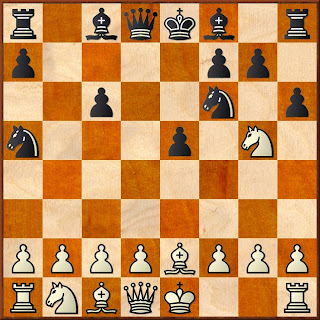 Diagram 1 - Position after 8… h6.
The previous post was inspired by a couple of games in the Two Knights Defense, a highly interesting opening first mentioned (according to the German Handbuch) by the Italian author Polerio in 1590.
1.e4 e5 2.Nf3 Nc6 3.Bc4 Nf6
This move defines the Two Knights Defense. Steinitz described “this defense is in reality a counter-attack on Black's third move, which being so early instituted ought to be disadvantageous to the second player on principle.”
4.Ng5
Against the principle of not moving the same piece twice in the openings, the ‘violator’ must have a very good, if not excellent, preparation otherwise the game will again become an affirmation of that principle.
Siegbert Tarrasch called 4.Ng5 a "duffer's move" (ein richtiger Stümperzug) and Oscar Panov called it "primitive", but this attack on f7 practically wins a pawn by force. Despite Tarrasch's criticism, many players consider 4.Ng5 White's best chance for an advantage and it has been played by World Champions Wilhelm Steinitz, Bobby Fischer, and Garry Kasparov.
Max Lange’s 4.d4 will be a subject for future posts.
4... d5
The Chess Connoisseur maintains this is Black’s most reasonable reply.
5.exd5 Na5
Both 5...Nd4!? (Fritz,A) and 5...b5!? (Ulvestad,O) are interesting alternatives for Black. On the other hand the immediate recapture 5... Nxd5?! is dangerous for Black. White obtains the initiative after 6.d4! Likewise interesting is the sacrifice 6.Nxf7!?
Black's alternatives to 5...Na5, the Fritz Variation 5... Nd4, and Ulvestad's Variation 5... b5, are related as they share a common subvariation. American master Olav Ulvestad introduced 5... b5 in a 1941 article in Chess Review. German master Alexander Fritz (1857–1932) suggested 5... Nd4 to Carl Schlechter, who wrote about the idea in a 1904 issue of Deutsche Schachzeitung. In 1907 Fritz himself wrote an article about his move in the Swedish journal Tidskrift för Schack. White's best reply is 6.c3, when the game often continues 6...b5 7.Bf1 Nxd5 8.Ne4 or 8.h4.
The recapture 5... Nxd5?! is very risky. Pinkus tried to bolster this move with analysis in 1943 and 1944 issues of Chess Review, but White gets a strong attack with either the safe Lolli Variation 6.d4! or the sacrificial Fried Liver (or Fegatello) Attack 6.Nxf7!? Kxf7 7.Qf3+ Ke6 8.Nc3. These variations are usually considered too difficult for Black to defend over the board, but they are sometimes used in correspondence play.
6.Bb5+
After 5... Na5, Morphy would play to hold the gambit pawn with 6.d3. The Morphy Variation has not been popular, since it has long been known that Black obtains good chances for the pawn with 6...h6 7.Nf3 e4 8.Qe2 Nxc4 9.dxc4 Bc5. (Bronstein once tried the piece sacrifice 8.dxe4!? with success, but its soundness is doubtful.)
6… c6 7.dxc6 bxc6 8.Be2
The move 8.Qf3?!, popular in the nineteenth century and revived by Bogoljubov in the twentieth, is still played occasionally, but Black obtains a strong attack after either 8... h6! or 8... Rb8.
8… h6
 Diagram 1 - Position after 8… h6.
White has a choice of retreat for the knight between the squares f3 (modern preference) and h3 (old preference). Which of them is best?
The Chess Connoisseur acknowledges and appreciates the various sources used in the preparation of this series.
(End of Part 1 of 3)
To be continued.
.
To be continued.
Saturday, October 17, 2009
Those who forget the past are destined to repeat it
ONE problem with playing ‘book’ moves is it reveals one's depth of preparation or the lack of it.
A quote from George Santayana (or was it Edward Burke?) goes like this: “Those who do not learn from history are bound to repeat it.” There are many variations to this quotation and like this one which similarly applies to chess: “Those who forget the past are destined to repeat it.”
This brings to mind a player’s failure to study openings and games of the masters of old that resulted to a painful loss due to ignorance.
During the 1970s and 1980s when the acknowledged chess bible was the semi-annually published Informator and when chess databases consisted of stacks of index cards or notebooks containing opening lines, it usually takes a month or two before any new opening move (novelty) is published in chess magazines or chess columns after it was played. While new moves or ideas become known to most and while some unsuspecting competitors—chess professionals included—fall prey to them when confronted, it was considered a grievous chess sin if one displays ignorance of old lines.
With the advent of computers a number of changes—mostly drastic and sweeping—chess databases are now in electronic form where the retrieval system is not only fast and efficient but much useful in preparing for a particular chess opening or specific opponent. Coupled with the advancement in communication technology, the Internet included, what was played in one part of the globe could be known by the rest of the world while the move or game is being played (‘live’ games) or just a few hours or minutes after the game. Top professionals monitor top level competitions as they happen to keep abreast with current trends.
The preparation of elite players are mimicked by budding players, particularly the monetary-endowed ones who can afford to purchase computers, chess books, chess software and other training stuffs. While there is nothing wrong in finding one’s self in this fortunate situation, the horrible thing is to see some players in this level boast about their relative ‘superiority’ over their less fortunate victims, or curse under their breath when beaten (‘upset’ is the kindest word commonly used) by apparently ‘inferior’ opponents. In the first instance, the well equipped player already has an undue advantage in that the playing field is not level. In the latter instance, the second player is either the more talented or ‘more prepared’ in coming up with an old (or even antique) move which the first player has not studied at all because his attention is always on what is current or fashionable.
Having modern chess tools at one’s disposal is not enough to propel one at the top. Talent alone, however, to the neglect of available training materials and stuffs could carry one up to a certain level only. To become really successful at the higher level it would be ideal to combine both talent and tools. (Those who do not fall into this category of players play chess for fun, for social reasons or simply for the love of it.)
It is not enough to learn modern chess opening theories one has to know the theories of old as well. It pays to know ‘old’ or ‘antique’ moves or variations (past) in order to avoid surprises over the board; surprises that could lead to a painful defeat specially losing a game like a patzer.
We will feature illustrative examples in our next post to illustrate the points raised here.
.
Tuesday, October 13, 2009
Ray Robson, USA’s youngest grandmaster ever!
 Ray Robson (Photo: wikipedia.org)
NO sooner than we made our prediction from the introductory statement of the last post that Ray Robson will obtain the grandmaster title did the breaking news come out that he has already done so by winning the Pan American Junior championship and became the youngest US grandmaster ever.
In so doing The Chess Connoisseur got both prediction and distinction correct but not the timeframe (‘before this year is over’). With the title, still to be confirmed by FIDE which is just a matter of procedure and formality, Robson (born October 25, 1994) beat by four days the record set by Fabiano Caruana two years ago.
Like a house on fire, Ray was in such a hurry that he beat his first seven opponents before allowing a draw in a superior position to secure the grandmaster norm and the title, on his way to winning the tournament with one round to go. For topping the event, he automatically earned a GM norm—his third, and accordingly the GM title since his rating is already above the 2500 minimum.
Although it was a relatively weak event with only one GM (Andre Diamant of Brazil, who he defeated the second time in less than 3 weeks; the first was at the SPICE Cup B in late September), it's apparently the case that winning the tournament confers an automatic GM norm on the victor.
Robson’s next assignment, his first as a grandmaster, will be the World Chess Cup to be held in Khanty-Mansiysk in November 2009. His acquiring the grandmaster title provides justice and adds credence to his nomination by the FIDE President to this event.
News of Robson’s recent feat may be found from here:
Breaking News! Robson is the newest American GM!
Ray Robson is the newest American GM!
Highlights of Ray Robson’s chess career:
• Pan American Youth Chess Championship in Brazil, tied for first; awarded the FIDE Master (FM) title in June 2005
• Earned the USCF National Master (NM) title in January 2006 by raising his chess rating above 2200 (the minimum required for the title of National Master).
• Earned the three norms needed for the IM title in only six weeks: the first at the 6th North American FIDE Invitational on November 3, 2007, in Chicago, Illinois
• Earned second IM norm on November 27 at the World Youth Chess Championship in Antalya, Turkey
• Earned third and final IM norm on December 10, 2008 at the University of Texas at Dallas (UTD) GM Invitational in Dallas, Texas, making him the youngest IM-elect in the United States.
• Tied for first place in the 2008 Florida championship.
• Won the U.S. Junior Chess Championship, becoming one of the youngest such champions ever on July 16, 2009.
• Tied for first at the Arctic Chess Challenge in Tromso, Norway in August of 2009 garnering his first GM norm in the process.
• Went on that same month to earn his second GM norm by winning the 23rd North American FIDE Invitational in Skokie, Illinois.
• Won the Pan American Youth Chess Championship in Uruguay, October 2009; earned his third and final GM norm and thus GM title .
Subscribe to:
Posts (Atom)


